
Most people assume salad season ends when the frost hits. But lettuce is one of the few crops that actually prefers cooler temperatures — which makes it a natural fit for growing inside your home during winter. The roots are shallow, the light needs are modest compared to crops like tomatoes, and you can go from seed to your first harvest in roughly four to six weeks. Learning how to grow lettuce indoors takes very little: a container, some potting mix, and a decent grow light. The rest is surprisingly simple.
Choosing Varieties That Do Well Indoors
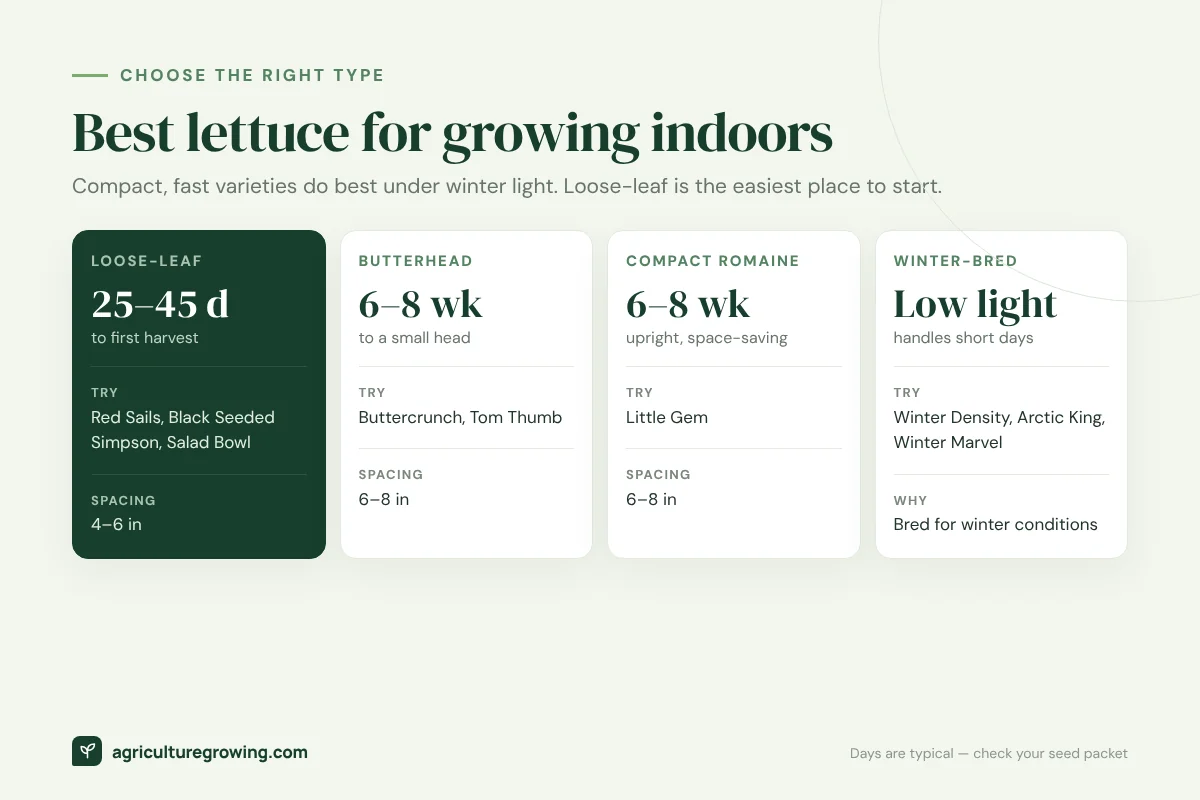
Some lettuce types handle indoor conditions much better than others. The key is picking varieties that stay compact, mature quickly, and don’t mind a bit less light than they’d get outside in June.
Loose-leaf lettuce is the easiest starting point. Red Sails, Black Seeded Simpson, and Salad Bowl are all popular choices. They skip the whole “forming a head” stage, which means they take up less room and grow faster — most are ready for a first harvest within 25 to 45 days. You can also snip outer leaves and let the plant keep growing, so one planting gives you several rounds of greens.
Butterhead types like Buttercrunch and Tom Thumb are worth trying, too. They form small, loose heads with soft, buttery leaves. They need a little more elbow room in the container than loose-leaf, but the texture and flavor make up for it.
Compact romaine varieties — Little Gem is probably the most well-known — grow upright rather than spreading out, so they’re a decent fit for tight spaces. They just take a couple of extra weeks to reach full size.
If you want varieties specifically bred for shorter days, look for Winter Density, Arctic King, or Winter Marvel. These handle low-light winter conditions better than types designed for summer growing.
Supplies You’ll Need
You can get started with very little:
- Seeds — A single packet is enough for many plantings.
- Shallow containers — Lettuce roots only reach about 4 to 6 inches deep, so you don’t need large pots. Any container with drainage holes works — nursery trays, window boxes, even repurposed takeout containers with a few holes punched in the bottom.
- Potting mix — A standard seed-starting mix or all-purpose potting soil is fine. Skip the heavy garden soil; it packs down too tight in pots and doesn’t drain well.
- A grow light — Almost always necessary for winter growing. More on this in the next section.
- A spray bottle — Handy for watering seedlings without washing the seeds around.
Why Light Matters Most
Of everything you need to get right, light is the one that makes or breaks indoor lettuce. Even a sunny south-facing window usually falls short during December and January, when the days are at their shortest and the sun sits low.
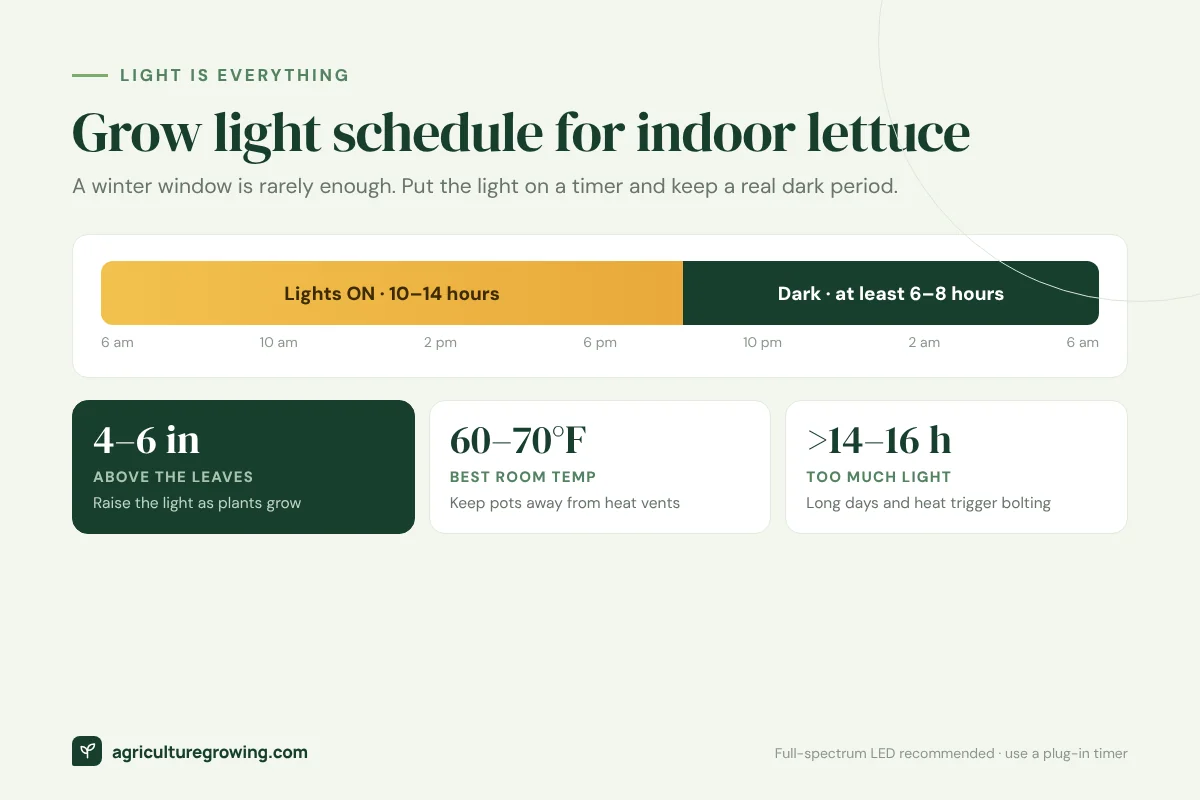
A grow light solves the problem. Lettuce does well with about 10 to 14 hours of light per day — less than what tomatoes or peppers would need, but more than a winter windowsill typically delivers.
Full-spectrum LED grow lights are the best option for most home growers. They’re affordable, run cool, and sip electricity compared to older fluorescent tubes. Even a basic LED shop light hung above your containers can work in a pinch.
Hang the light about 4 to 6 inches above the tallest leaves. Too far away, and your seedlings will stretch toward it and grow tall and spindly instead of bushy. Too close, and the leaves might dry out. Raise the light as the plants grow to keep that gap consistent.
One detail people overlook: lettuce still needs a dark period. Keep the lights off for at least 6 to 8 hours a day. A plug-in timer takes the guesswork out of this — set it once and forget about it.
How to Grow Lettuce Indoors: Planting the Seeds
Lettuce seeds are small, so there’s no need to be too precise. Here’s a simple process:
- Fill your container with moistened potting mix, leaving about half an inch of space below the rim.
- Scatter seeds across the surface, aiming for roughly half an inch between them. Close enough is fine — you’ll thin them later.
- Press the seeds gently into the mix, then cover them with only a very thin layer of mix, about ⅛ inch. Lettuce needs a bit of light to germinate, so don’t bury them.
- Mist the surface until it’s evenly damp.
- Set the container under your grow light or in your brightest window.
You should see sprouts in about 7 to 10 days. Lettuce germinates best when the soil is between 60°F and 75°F — a range most heated homes hit without any extra effort.
After the seedlings grow their first set of true leaves (those are the second pair, not the initial rounded ones), thin them out. Give loose-leaf varieties about 4 to 6 inches of space, and butterhead or romaine about 6 to 8 inches. It feels like you’re sacrificing plants, but the ones you leave behind will grow much stronger without the crowding. And those thinnings? They’re perfectly good eating — toss them straight into a salad.
Keeping the Soil, Water, and Temperature Right
Soil pH between 6.0 and 6.8 is the sweet spot for lettuce. Most bagged potting mixes already land in that range, so this usually takes care of itself.
Water is straightforward — keep the soil damp but not soggy. Poke your finger about an inch into the mix. If it feels dry, water it. If it still feels moist, wait a day. For seedlings, a spray bottle gives you the most control. Once plants are bigger, pour water at the soil line rather than over the leaves. Soggy foliage invites fungal problems you’d rather avoid.
Pots sitting under grow lights dry out quicker than you might expect, so get in the habit of checking daily.
Temperature is where indoor growing actually has an edge. Lettuce thrives between 60°F and 70°F — cooler than most people keep their homes, but close enough. The main thing to avoid is heat. Don’t put containers next to heating vents, radiators, or space heaters. Too much warmth makes the leaves taste bitter and can push the plant to bolt — that’s when it shoots up a flower stalk and quits producing good leaves.
If your containers sit on a windowsill, pull them back from the glass on very cold nights. The temperature right against the window can dip much lower than the rest of the room.
Fertilizing Without Overdoing It
Container-grown lettuce benefits from occasional feeding because nutrients wash out every time you water. But lettuce isn’t greedy — a little goes a long way.
Wait until the seedlings have a few sets of true leaves, usually two to three weeks after germination. Then start applying a balanced, water-soluble fertilizer (10-10-10 or similar) at half the strength listed on the label. Once every two weeks is enough.
Fish emulsion and liquid seaweed are solid organic alternatives. Both provide nitrogen, which is the nutrient lettuce cares about most — it’s what drives leafy growth and keeps the color a healthy green.
Here’s the catch: too much fertilizer — particularly nitrogen — can make the leaves bitter. If the plants look healthy and the growth looks steady, you’re probably giving them enough. More isn’t always better.
When and How to Harvest
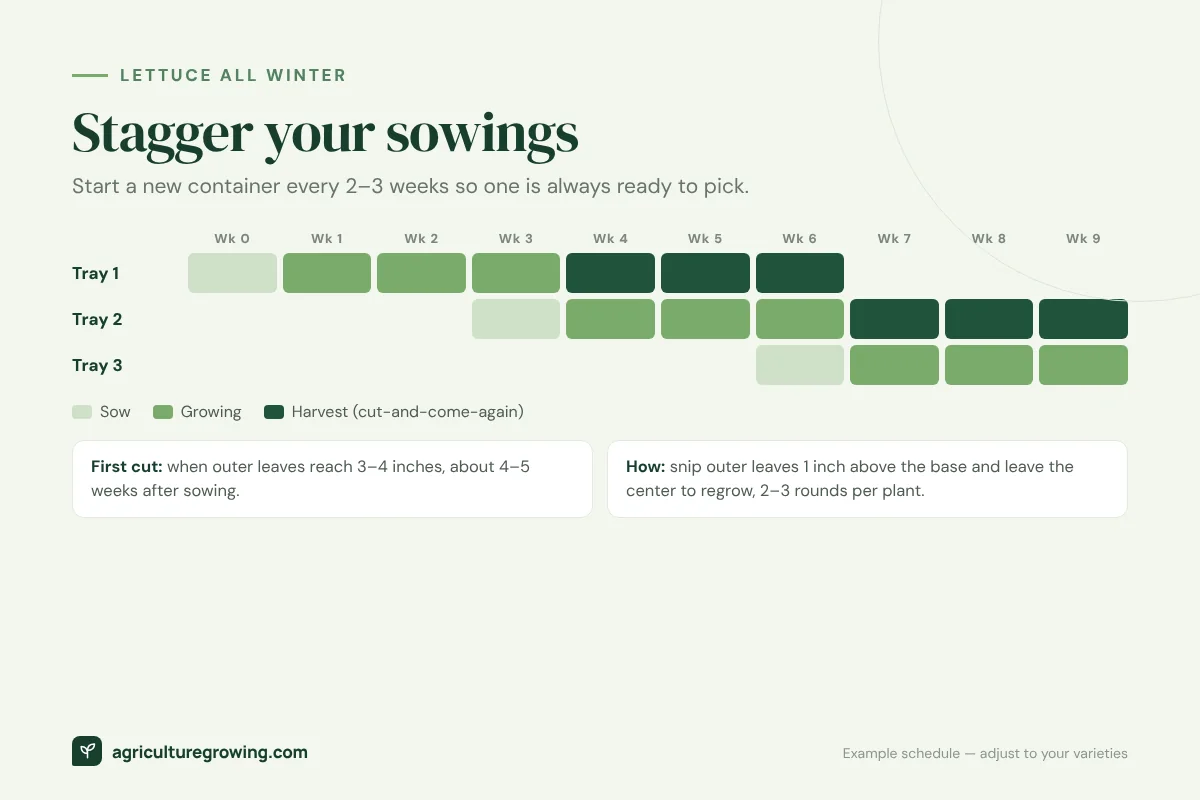
Loose-leaf lettuce is ready for its first cut once the outer leaves reach about 3 to 4 inches long. That usually happens four to five weeks after planting.
The smartest approach is cut-and-come-again harvesting. Snip the outer leaves about an inch above the base, leaving the small center leaves alone. The plant keeps pushing out new growth from the middle. You can usually get two or three good rounds of leaves this way before the plant runs out of steam.
If you’d rather harvest the whole plant, just wait until it reaches a decent size and cut it at the soil line.
The real trick to having lettuce all winter is staggering your plantings. Start a fresh container every two to three weeks. That way, you always have plants at different stages — one tray producing, another growing up, and a third just sprouting. By mid-winter, the cycle runs itself.
Troubleshooting Common Issues
Growing lettuce indoors sidesteps most of the pest and disease headaches you’d deal with in the garden. But a few problems can still pop up.
Tall, skinny seedlings are a sign of not enough light. Lower the grow light, run it for a couple more hours each day, or consider upgrading to a brighter fixture.
Yellow or wilting leaves usually point to a watering problem — and indoors, overwatering is the more likely culprit. Make sure water drains freely from the container and that pots aren’t sitting in a saucer full of water.
Bitter leaves happen when the plant is stressed. Heat, uneven watering, and waiting too long to harvest are the usual causes. Keeping the room cool and picking leaves on time prevents most bitterness.
Bolting — when the plant suddenly sends up a tall stalk — means it’s switching from leaf production to seed production. Heat and excessively long light periods (more than 14 to 16 hours) are common triggers. Once a plant bolts, the flavor is gone. Pull it and plant something new.
Aphids sometimes show up indoors. They tend to gather on the underside of leaves. A strong spray of water knocks most of them off, and insecticidal soap handles the rest. Fungus gnats — those tiny flies hovering around the soil — thrive in constantly wet conditions. Letting the top layer of soil dry between waterings discourages them. Yellow sticky traps placed near the pots catch the adults.
Damping-off is a fungal problem that kills seedlings at the soil line. They keel over as if someone pinched the stem. It’s caused by too much moisture and not enough air circulation. Fresh potting mix, clean containers, and a small fan running on low nearby go a long way toward preventing it.
Frequently Asked Questions
Can I grow lettuce indoors without a grow light? Only if you have a very bright, south-facing window that gets at least 6 hours of direct sun. During the shortest winter days, that’s hard to come by in most homes. A grow light gives you much more reliable results.
How long does indoor lettuce take to grow? Loose-leaf types mature in about 4 to 5 weeks. Butterhead and romaine take 6 to 8 weeks. Under artificial light, things may run a bit slower than under full summer sun, but the difference is usually just a few days.
Can you regrow lettuce from a store-bought head? Technically, yes — placing the base in water will produce a few small leaves. But the regrowth is thin and doesn’t amount to much of a harvest. Seeds are cheap and give you far better results.
Is it cheaper than buying lettuce at the store? A basic setup — grow light, seeds, potting mix — costs roughly $30 to $50. Those supplies can produce multiple rounds of lettuce across an entire winter. If you normally buy pre-washed salad greens or organic lettuce, the math starts working in your favor pretty quickly.
What’s the best container for indoor lettuce? Anything shallow (4 to 6 inches deep) with drainage holes. Seed trays, window boxes, and recycled food containers all work well. With lettuce, surface area matters more than depth because the roots stay near the top.
Final Thoughts
Winter doesn’t have to mean months of store-bought salad greens. A few containers, a bag of potting mix, and an LED grow light are all it takes to keep fresh lettuce growing on a shelf or countertop from November through March. Loose-leaf varieties are the easiest place to start — they grow fast, tolerate beginner mistakes, and give you multiple harvests from a single planting. Stagger your sowings every couple of weeks, and you’ll have a steady rotation of greens ready to pick whenever you want a salad.