
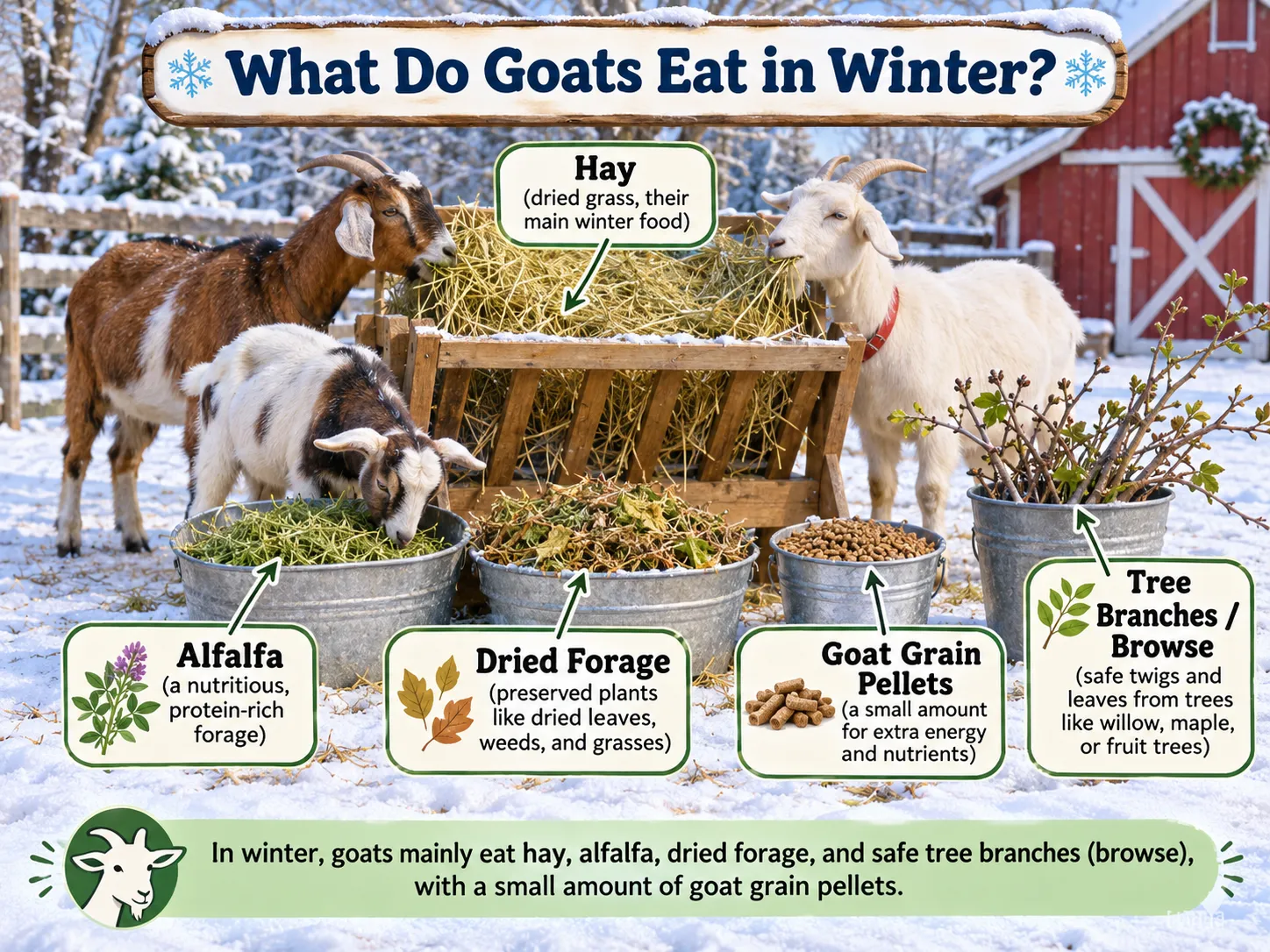
Once the pasture turns brown and the brush loses its leaves, your goats depend on you for almost everything they eat. So, what do goats eat in the winter? The short answer is mostly hay, plenty of unfrozen water, and a loose goat mineral, with grain added only for the goats that truly need it.
That sounds simple, but winter is when many goat keepers run into trouble. Poor hay, a frozen bucket, or a sudden scoop of grain can lead to weight loss, bladder stones, or a sick rumen. Below, you’ll find what to feed, how much, which goats need extra help, and a few winter hazards that catch new owners off guard.
What Goats Eat in Winter: The Diet at a Glance
| Feed | What it does | Which goats need it |
|---|---|---|
| Good-quality hay | Main source of energy, protein, and fiber | All goats |
| Fresh, unfrozen water | Keeps digestion working and helps prevent bladder stones | All goats |
| Loose goat mineral | Supplies trace minerals and vitamins | All goats |
| Grain or pelleted goat feed | Adds extra energy | Late-pregnant does, milking or nursing does, kids, thin goats |
| Safe browse and small treats | Variety and something to do | Optional, in small amounts |
Hay Is the Foundation of Winter Feeding
Once grazing ends, hay becomes your goats’ main meal. Extension specialists at Oklahoma State and the University of Arkansas call it the primary source of nutrients for goats in winter. It supplies most of the protein, energy, and fiber they get each day.
Why Fiber Keeps Goats Warm
Goats are ruminants. They digest food by fermenting it in a large stomach chamber called the rumen, and that fermentation gives off heat.
A lot of people reach for the grain scoop when the temperature drops. Oregon State University Extension calls that a common misunderstanding. Body heat comes from breaking down fiber, so a rumen full of hay works like a built-in furnace. On a cold night, a full hay feeder does more good than a bowl of grain.
Grass Hay vs. Alfalfa
Grass hay, such as timothy, orchardgrass, or coastal bermudagrass, works well for most adult goats that aren’t pregnant or in milk.
Alfalfa and other legume hays are higher in protein and calcium. That extra boost suits pregnant and milking does. For bucks and wethers, though, a mostly-alfalfa diet can cause problems. Langston University notes that legumes have a very high calcium-to-phosphorus ratio, and South Dakota State University Extension links high-legume diets to one type of urinary stone in male goats. That’s why grass hay is usually the safer choice for males.
How Much Hay Does a Goat Eat?
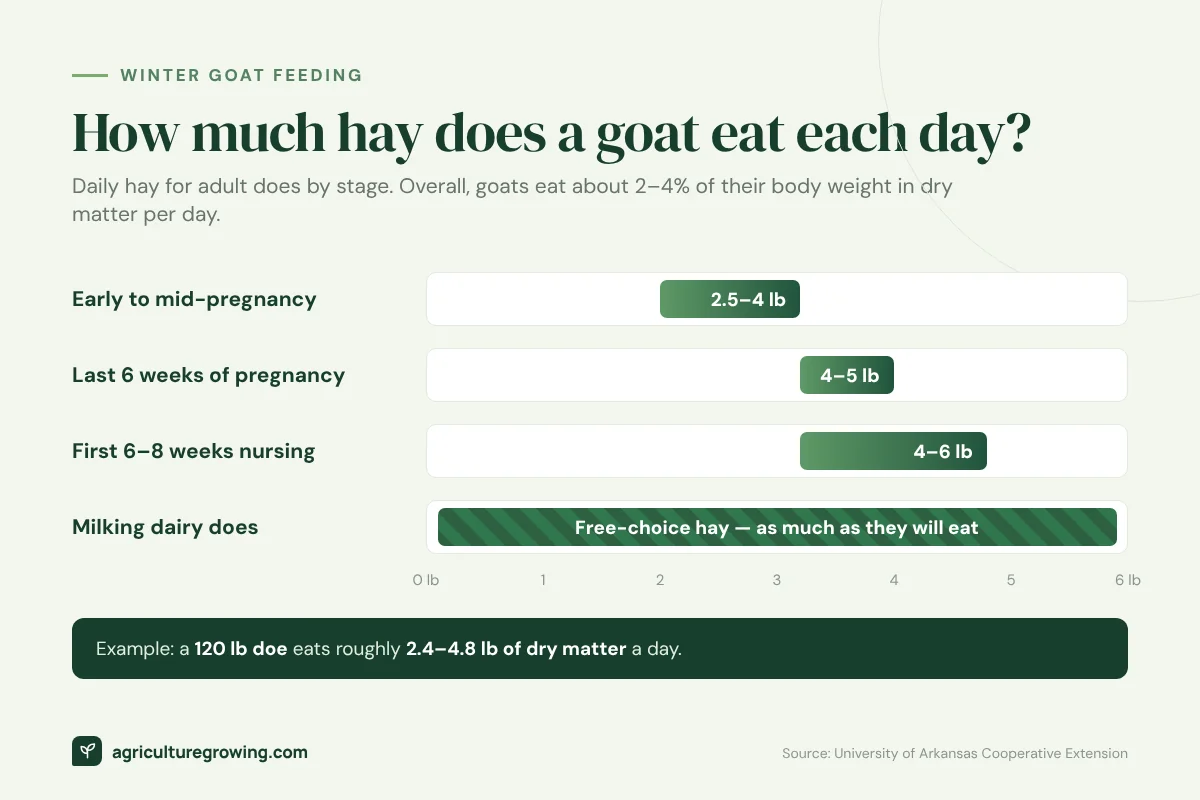
According to University of Arkansas guidelines, sheep and goats eat about 2% to 4% of their body weight in dry matter each day. A 120-pound doe would eat roughly 2.4 to 4.8 pounds of dry matter daily.
For adult does, those guidelines break it down by stage:
- Early to mid-pregnancy: 2.5 to 4 pounds of hay
- Last six weeks of pregnancy: 4 to 5 pounds of hay
- First six to eight weeks of nursing: 4 to 6 pounds of hay
- Milking dairy does: free-choice hay
Goats pull hay out of the feeder, drop it, and usually won’t touch what’s been trampled. Penn State Extension says every sheep and goat operation loses some hay in winter. A feeder that keeps hay off the ground can save you real money.
Planning Your Winter Hay Supply
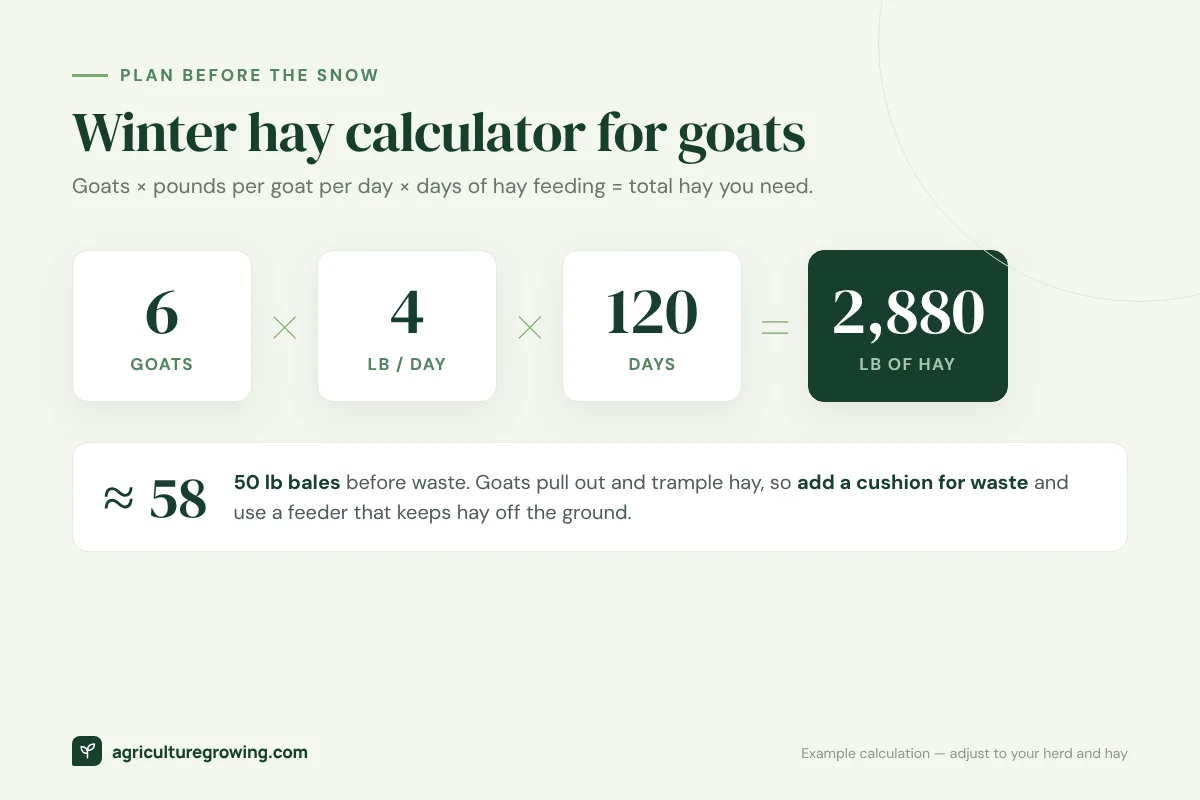
Working out how much hay to buy is simple multiplication: number of goats × pounds per goat per day × days of hay feeding. For example, 6 goats eating 4 pounds a day for 120 days need about 2,880 pounds of hay. If your bales weigh around 50 pounds, that’s roughly 58 bales before you add a cushion for waste. Hay prices often climb in a hard winter, so our guide on why winter feed costs rise and how to control them can help you stretch your budget.
Test Your Hay If You Can
Hay quality varies a lot, even between cuttings from the same field. Oklahoma State’s goat production handbook says a forage lab test is the only way to know what’s really in it. Your county extension office can usually help you send a sample. The handbook lists typical costs of about $10 to $12 per sample, though prices vary by lab.
Can’t test? Then use your eyes and nose. Good hay is green, leafy, and smells sweet. Pass on bales that are moldy, dusty, or full of thick stems and weeds.
Water: The Most Overlooked Winter Need
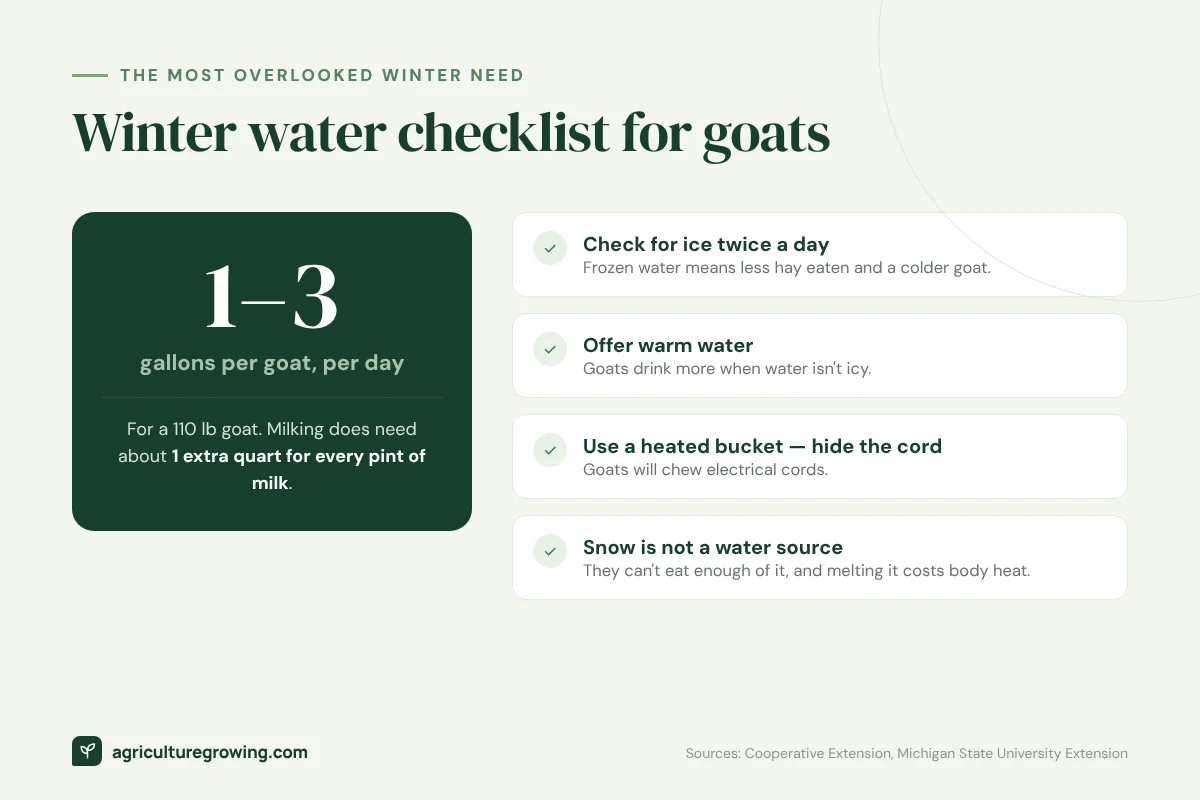
The University of Kentucky’s Master Grazer program explains the chain reaction. When the water freezes, animals can’t eat enough extra feed to handle the cold. Icy water also makes them drink less. Less water means less hay eaten, and less hay means a colder goat.
The Cooperative Extension goat resource says a 110-pound goat needs about 1 to 3 gallons of water a day, toward the lower end in winter. A milking doe needs about 1 extra quart for every pint of milk she produces. The same source recommends warm water in winter to encourage drinking.
To keep water flowing:
- Check water at least twice a day for ice.
- Consider a heated bucket or a tank heater.
- Keep electrical cords well out of reach. Michigan State University Extension warns that goats may chew them.
- Direct overflow away from the waterer so the area doesn’t turn into mud or ice.
Minerals and Salt
Winter hay alone may not supply every mineral a goat needs. University of Arkansas guidelines recommend a loose, free-choice mineral premix over blocks.
When you shop, check that the mineral:
- Is labeled specifically for goats
- Has about twice as much calcium as phosphorus (a 2:1 ratio)
- Includes vitamins A, D, and E
- Contains selenium if you live in a selenium-deficient area
Don’t swap in sheep mineral. It’s made with little or no added copper because sheep are sensitive to copper, and goats need more. It’s also worth keeping free-choice salt out. SDSU Extension says salt encourages goats to drink, which matters a lot in cold weather.
Grain: Helpful for Some Goats, Risky for Others
Many adult goats don’t need grain at all. Oregon State University Extension says most can maintain themselves on good grass hay, minerals, and water alone.
Grain earns its place when your hay is poor or when a goat needs more energy than hay can give. Michigan State University Extension suggests that in very cold weather, cracked corn, oats, sweet feed, or a complete pelleted feed can add extra calories, especially for late-pregnant does.
General Grain Amounts
University of Arkansas guidelines give these rules of thumb:
- Last six weeks of pregnancy: 0.5 to 1 pound of grain per doe per day
- Early nursing period: about 1 pound of grain per kid she’s nursing
- Dairy does in mid-lactation: 1 pound of grain per 3 pounds of milk
- Dairy does in late lactation: 1 pound of grain per 5 pounds of milk
Treat these as starting points and adjust for your hay and your goats.
Introduce Grain Slowly
A sudden jump in grain can cause rumen acidosis, also called grain overload. It happens when grain ferments too quickly and the rumen becomes too acidic. Warning signs include bloating, diarrhea, teeth grinding, depression, and loss of appetite. Severe cases can be fatal.
These habits lower the risk:
- Start with a small amount and increase it gradually. The NSW Department of Primary Industries recommends bringing grain in over about two weeks.
- Split grain into two or more meals a day.
- Store feed bags where goats can’t break in.
Be Careful With Bucks and Wethers
Male goats, especially wethers, are at risk of urinary calculi. These are mineral stones that block the urinary tract, and the condition can be deadly. University of Maryland Extension explains that diets high in grain and low in roughage raise the risk.
On the bright side, Langston University reports that the problem is almost nonexistent in goats fed little or no grain, except in some western areas with high-silica pastures. So for most wethers and bucks, the safest winter diet is grass hay, water, and loose minerals. If you do feed them grain, use a goat feed with a balanced calcium-to-phosphorus ratio. Many goat feeds also contain ammonium chloride to help prevent stones, so check the label.
Goats That Need Extra Attention in Winter
Some goats need more from you than others when it’s cold:
- Does in late pregnancy: Growing kids take up space in the belly, so the doe can’t eat as much at once. University of Nebraska–Lincoln Extension warns that goats with a body condition score above 4 (on a 5-point scale) are more prone to pregnancy toxemia, so aim for a fit doe, not a fat one.
- Milking and nursing does: The Cooperative Extension goat resource suggests giving your best forage to lactating goats first.
- Kids and young goats: The same source advises never cutting feed quality or quantity for growing animals.
- Older, sick, or thin goats: Oregon State notes these animals handle cold stress less well.
Shelter affects feeding, too. Penn State Extension says wet, cold conditions raise a goat’s energy needs. Goats don’t need elaborate housing, according to Michigan State University Extension, but they do need a place that blocks harsh wind and keeps them dry.
Check Body Condition by Hand
A thick winter coat can hide weight loss. Run your hands along the spine and over the ribs. Extension goat specialists recommend checking at least once a month, and more often during cold spells. If a goat feels bony, increase hay quality first, then consider adding grain.
Safe Extras and Winter Treats
Goats that aren’t in milk can pick through leftover garden plants or corn stalks, as long as hay and minerals stay available. Treats like carrots or apple slices are fine in small amounts. Oklahoma State notes that bread, apples, and other high-carbohydrate foods can trigger the same grain overload described above if goats eat too much.
Christmas trees are a popular after-holiday snack, but be careful where they come from. Feed only trees you know weren’t sprayed with chemicals. An extension expert on Ask Extension also advised against feeding pine to pregnant goats, since pine can be toxic in larger amounts.
Never feed yew. Japanese and English yew are common landscaping shrubs and are extremely poisonous. Purdue Extension notes that as little as half a pound of clippings may be fatal to a 500-pound animal, so a small goat needs far less. Keep holiday wreaths and hedge trimmings far from the pen.
Frequently Asked Questions
Can goats live on hay alone in winter?
Most healthy adult goats that aren’t pregnant or in milk can do well on good-quality hay, loose minerals, and clean water. Pregnant does, milking does, kids, and thin goats often need extra energy from grain or better hay, such as alfalfa.
Should I feed goats more when it gets colder?
Yes. Goats eat more in harsh weather to stay warm, so offer more hay or keep it available free-choice. If a goat is already eating all the hay it can and still losing weight, slowly add a higher-energy feed like grain.
Can goats eat snow instead of drinking water?
Snow isn’t a reliable water source. Goats can’t eat enough of it to meet their daily needs, and warming it up inside the body costs energy. Always provide fresh water that isn’t frozen, even when snow covers the ground.
Final Thoughts
Winter goat feeding comes down to a few habits done well: steady access to good hay, water that never freezes, and a loose mineral made for goats. Save grain for the goats that truly need extra energy, and introduce it slowly. If you haven’t yet, work out your hay numbers and make sure your water setup can handle a hard freeze. Then keep putting your hands on your goats every few weeks. Small, steady habits like these help a herd reach spring in good condition.
Still planning your herd? Compare popular goat breeds around the world or read our complete guide to raising Boer goats.