
Every gardener eventually faces the same question: Should I feed my vegetables with compost or chemical fertilizer? Both options add nutrients to the soil, but they do so in very different ways—and those differences affect everything from plant growth to long-term soil health.
Whether you’re a beginner just starting your first vegetable garden or an experienced grower looking to refine your gardening practices, understanding the difference between compost and fertilizer will help you make smarter choices. So let’s break down how each one works, what it does for your plants, and which one actually grows better vegetables.
Understanding What Plants Need
Before comparing compost and fertilizer, it helps to understand what plants need to grow. All vegetables require three primary macronutrients: nitrogen, phosphorus, and potassium. These are often referred to by their chemical symbols—N, P, and K—and you’ll see them listed as the NPK ratio on any bag of fertilizer.
Nitrogen drives leafy green growth. Phosphorus and potassium support root development, flowering, and fruit production. Beyond these three, plants also require a range of secondary nutrients and micronutrients, such as calcium, zinc, magnesium, iron, and manganese. These elements work together to support healthy plant growth throughout the season.
Both compost and chemical fertilizer deliver nutrients to your garden, but the way they do it—and what else they bring to the table—is where the real differences lie.
What Is Chemical Fertilizer?
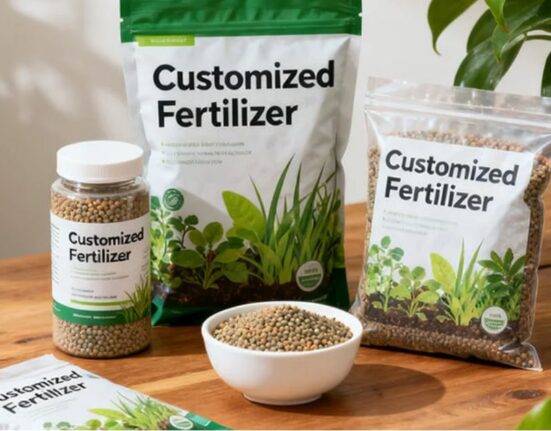
A chemical fertilizer (also called synthetic fertilizer or inorganic fertilizer) is a manufactured product designed to deliver specific amounts of nutrients directly to plants. The most common example is a bag of 10-10-10 synthetic fertilizer, which contains 10% nitrogen, 10% phosphorus, and 10% potassium by weight.
How Synthetic Fertilizer Works
Synthetic fertilizers are produced through industrial processes that extract and concentrate specific nutrients into forms immediately available to plants. When you apply a 10-10-10 synthetic fertilizer to your garden beds, the nutrients dissolve in water and become accessible to plant roots almost instantly.
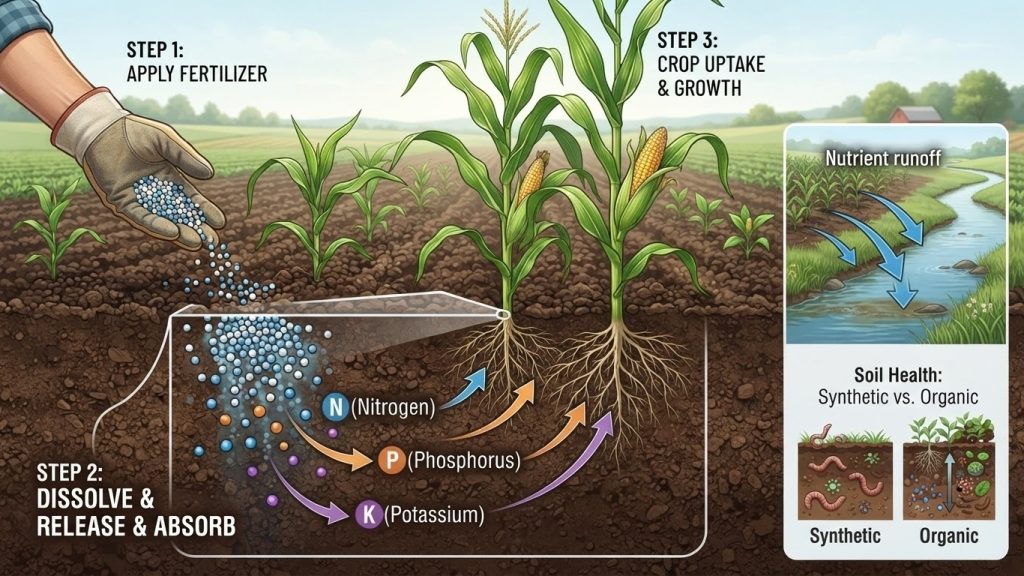
This fast delivery is both the biggest strength and the biggest weakness of chemical fertilizers. On one hand, if your plants are showing signs of nutrient deficiency—yellowing leaves, stunted growth, poor fruiting—a synthetic fertilizer can correct the problem quickly. On the other hand, because nutrients are so readily available, they can also be washed away by rain or irrigation, contributing to runoff that ends up in local waterways.
The NPK Advantage
One clear advantage of synthetic fertilizers is precision. You know exactly what amount of nutrients you’re applying, and you can choose formulations tailored to specific crops. A high nitrogen fertilizer works well for leafy greens, while a higher-phosphorus blend supports tomatoes and peppers during fruiting.
However, most synthetic fertilizers only provide the three major nutrients. They don’t add micronutrients, they don’t improve soil structure, and they don’t feed the billions of soil microbes that keep your garden ecosystem functioning.
What Is Compost?
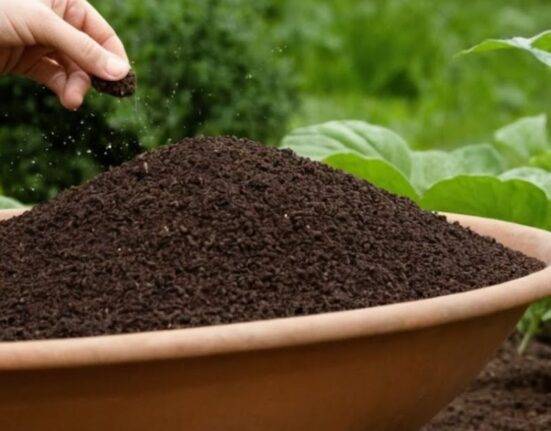
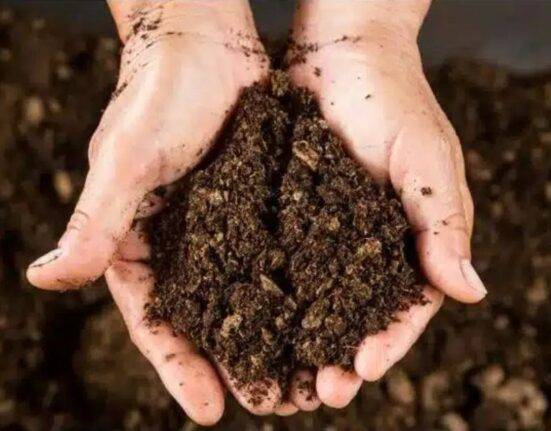
Compost is decomposed organic material—things like food scraps, yard waste, leaves, grass clippings, and manure that microorganisms have broken down into a dark, crumbly, earthy-smelling substance. It’s often called “black gold” by gardeners because of how dramatically it can improve soil quality.
How Compost Works
Unlike synthetic fertilizer, compost works slowly and holistically. When you apply compost to your garden, you’re not just adding nutrients—you’re adding organic matter that transforms the physical and biological properties of your soil.
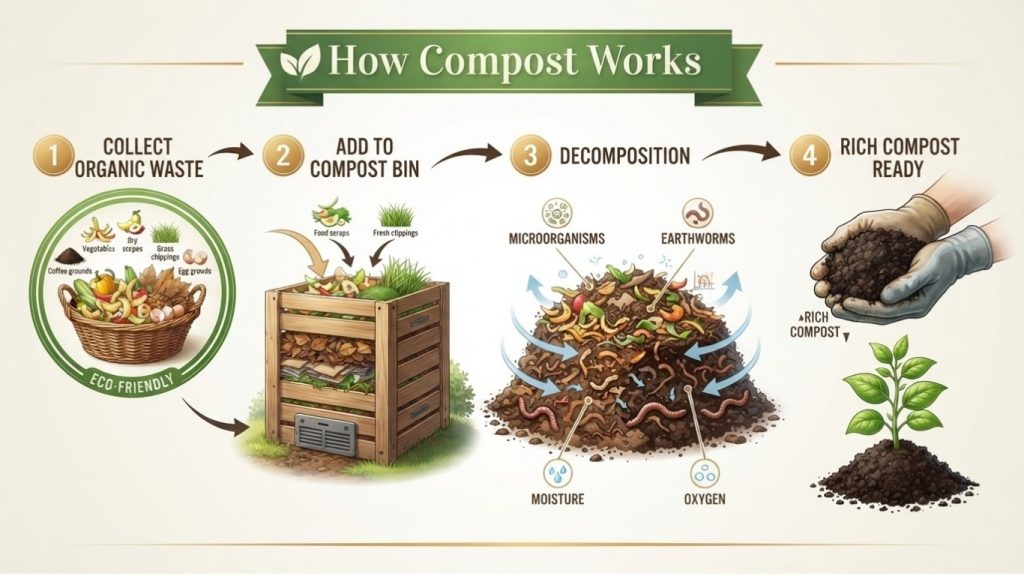
Compost improves soil structure by creating air pockets that allow roots to breathe and water to drain properly. It increases water retention in sandy soils and improves drainage in clay soils. It feeds earthworm populations and supports a thriving community of beneficial bacteria and fungi that help break down organic matter into forms plants can use.
The nutrients in compost are released slowly as microorganisms continue to decompose the material. This slow-release process means your plants receive a steady supply of nutrition throughout the season rather than a single burst that quickly washes away.
Compost’s Nutrient Profile
Here’s where some gardeners get confused. Compost doesn’t have a standardized nutrient profile like synthetic fertilizer does. A batch of compost made primarily from food scraps will have a different nutrient content than one made from cow manure or yard waste. Generally, finished compost contains about 1-3% nitrogen, 0.5-1% phosphorus, and 1-2% potassium.
Those numbers look low compared to a bag of 10-10-10 synthetic fertilizer. But the comparison isn’t quite that simple, because compost delivers so much more than just NPK.
The Case for Compost in Vegetable Gardens
Long-Term Soil Health
The single biggest argument for using compost in vegetable gardens is its impact on long-term soil health. Every time you apply compost, you’re building organic matter content in your soil. This organic matter acts like a sponge, helping soil hold water and nutrients, making them available to plants over extended periods.
After years of repeated compost applications, your soil becomes a living, thriving ecosystem. Earthworms tunnel through it, creating channels for water and air. Beneficial bacteria and fungus species form relationships with plant roots, helping them access nutrients more efficiently. Humic substances—complex organic molecules created during decomposition—bind to minerals and make them available to plants in forms they can easily absorb.
This biological activity is something that synthetic fertilizer cannot replicate. In fact, years of repeated use of only synthetic inputs can actually deplete organic matter and harm soil biology over time.
Compost Improves Everything
When you add quality compost to your garden beds, you’re improving:
Soil structure – Compost creates a loose, crumbly texture that roots love. This makes it easier for plants to spread their root systems and access water and nutrients.
Water retention – Soils rich in organic matter can hold significantly more water than depleted soils. This means less frequent watering and more drought-resistant plants.
Nutrient availability – Compost feeds soil microbes, which in turn release nutrients in forms that plants can uptake efficiently. It’s a natural, self-sustaining cycle.
Disease suppression – Healthy soil biology actually helps suppress plant diseases. Beneficial microorganisms in compost compete with pathogenic ones, helping keep your vegetables healthier.
Applying Compost in Your Garden
The standard recommendation is to spread 1-3 inches of compost on top of your garden beds each season—ideally in spring before planting and again in fall after harvest. You can also use compost as a side dressing throughout the season by adding a thin layer around the base of established plants.
Applying compost is simple: spread it on top of the soil and let the earthworms and rain work it in naturally. There’s no risk of “burning” your plants because compost releases nutrients slowly and gently. This forgiving nature makes it an excellent choice for beginning gardeners who worry about over-fertilizing.
The Case for Chemical Fertilizer
Immediate Results
If your plants are hungry right now—if they’re showing deficiency symptoms or you’re growing a lot of heavy-feeding crops—synthetic fertilizer offers an immediate solution. The nutrients are already in a form that’s directly available to plants, so that you can see results within days rather than weeks.
For commercial growers, homeowners, and landscapers managing large areas, this speed matters. When you need to fertilize a large vegetable garden mid-season, applying a synthetic fertilizer gets nutrients to struggling plants fast.
Precision Feeding
With chemical fertilizer, you can target exactly which nutrient your plants need. A soil test might reveal that your garden is low in phosphorus but has adequate nitrogen. With synthetic fertilizer, you can apply a phosphorus-only product to correct the specific deficiency without adding more of what you don’t need.
This precision is harder to achieve with compost alone, because compost contains a broad but variable mix of nutrients. You can’t easily control the exact ratio of nitrogen to phosphorus and potassium in a compost pile.
Lower Volume Needed
Because synthetic fertilizers are concentrated, you need far less material to deliver the same amount of nutrients. A 25-pound bag of fertilizer might feed your entire garden for a season, while achieving similar nutrient levels with compost could require hundreds of pounds of material. For gardeners without easy access to large quantities of compost, this matters.
The Disadvantages of Chemical Fertilizer
Despite its convenience, synthetic fertilizer has serious drawbacks that every gardener should understand.
It Doesn’t Build Soil
The biggest disadvantage of relying solely on chemical fertilizers is that they do nothing to improve soil quality. It adds nutrients, yes, but it doesn’t add organic matter. Over time, soil fed exclusively with synthetic inputs loses its structure, its biology, and its ability to support healthy plant growth without continued chemical intervention.
Think of it this way: synthetic fertilizer feeds the plant, but compost feeds the soil. And healthy soil naturally grows healthy plants.
Environmental Concerns
Synthetic fertilizers are highly soluble, which means they can easily leach from the soil during heavy rain or overwatering. This runoff carries concentrated nitrogen and phosphorus into streams, rivers, and lakes, where it causes eutrophication. In this process, excess nutrients trigger massive algal blooms that deplete oxygen and kill aquatic life.
This isn’t a minor issue. Agricultural runoff is one of the leading causes of waterway pollution worldwide. While home gardeners contribute less than commercial farms, the cumulative impact of thousands of yards and gardens using synthetic fertilizer adds up.
Soil Biology Damage
Chemical fertilizers, particularly when used heavily over many seasons, can harm the microorganism populations that keep soil alive and healthy. High salt content in some synthetic products damages earthworm populations and kills beneficial bacteria. Over time, this creates a cycle in which you need to fertilize more and more because the natural systems that release nutrients have weakened.
Soil microbes break down organic material, making nutrients available to plants. When these populations decline, even nutrient-rich soil can become unproductive.
The Disadvantages of Compost
Compost isn’t perfect either. Let’s be honest about its limitations.
Lower Nutrient Concentration
Compost doesn’t have the same nutrient concentration as synthetic fertilizer. If your garden beds need a significant boost of a specific nutrient—say, nitrogen for heavy-feeding corn—compost alone may not deliver enough in time. This is especially true in the first year or two of a new garden when the soil hasn’t had time to build up its nutrient reserves.
Inconsistent Nutrient Content
Because compost is made from variable inputs, its nutrient profile changes from batch to batch. Compost made from chicken manure will be much higher in nitrogen than compost made primarily from leaves and wood chips. Without testing, you don’t know exactly what you’re adding to your soil.
Volume and Availability
You need a lot of compost to feed a large vegetable garden adequately. Not everyone has access to enough organic material to produce sufficient compost at home. While you can buy compost in bags or bulk, quality compost from a reputable source costs money—and cheap compost may contain weed seeds, pesticide residues, or other contaminants.
Time to See Results
Compost works on nature’s timeline, not ours. Because it functions as a slow-release amendment, it can take weeks or months for the nutrients it releases to become available to plants. If you need results now, compost alone won’t deliver them quickly enough.
Can You Use Both Together?
Absolutely—and many experienced gardeners do exactly this. Using compost and fertilizer together gives you the best of both worlds: immediate nutrient availability from the fertilizer and long-term soil building from the compost.
A practical approach is this: amend the soil before planting with several inches of high-quality compost to improve structure and biology, then apply a moderate amount of fertilizer (organic or synthetic) to ensure plants have enough nutrients during their heaviest growth periods.
Over time, as your soil improves through consistent compost additions, you’ll likely find that you need to fertilize less and less. The soil itself becomes capable of providing what plants need to grow, especially if you’re also using organic fertilizers like bone meal, blood meal, or composted manure to supplement.
Organic Fertilizers: The Middle Ground
We’ve been comparing compost to synthetic fertilizer, but there’s a middle ground worth discussing: organic fertilizers. These are concentrated nutrient sources derived from natural materials rather than industrial processes.
Common Organic Fertilizers
Blood meal – A high nitrogen fertilizer made from dried animal blood. It breaks down relatively quickly and provides a nitrogen boost without the environmental risks of synthetic products.
Bone meal – Rich in phosphorus and calcium, bone meal supports root development and flowering. It’s a slow-release product that feeds plants over several months.
Cow manure – Well-composted cow manure adds both nutrients and organic matter to soil. It’s gentler than chicken manure but still effective for vegetable gardens.
Chicken manure – Higher in nitrogen than most other animal manures, chicken manure must be composted before use to avoid burning plants. Once composted, it’s an excellent all-around fertilizer.
Compost tea – A liquid extract made by steeping finished compost in water. Compost tea delivers nutrients directly to plant roots or can be sprayed on leaves as a foliar feed. It’s also rich in beneficial microorganisms that boost soil biology.
Why Use Organic Fertilizers?
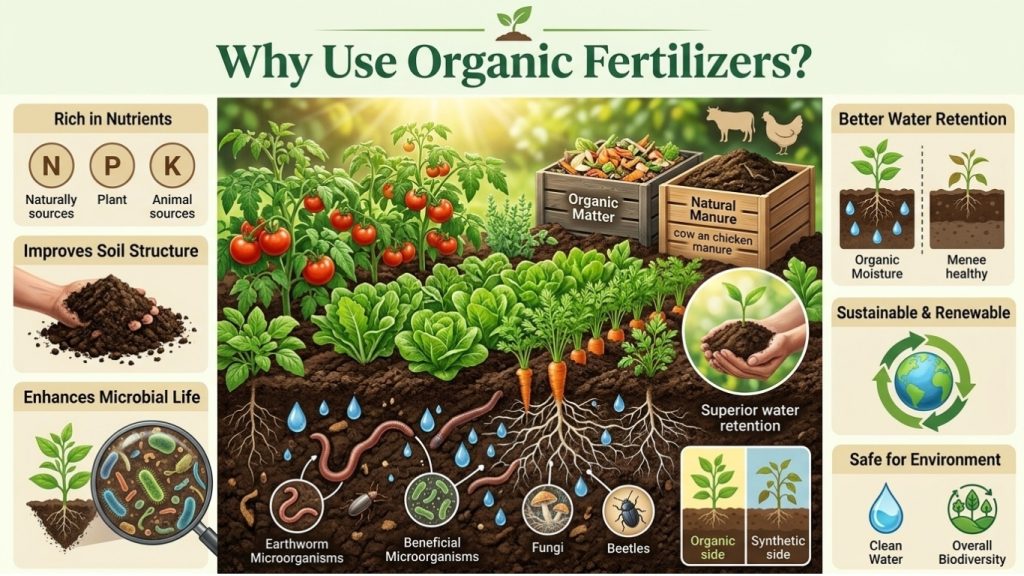
Using organic fertilizers bridges the gap between compost and synthetic products. They provide more concentrated nutrition than compost alone, but they also feed soil microbes and break down into organic matter over time. When you use some organic fertilizers alongside regular compost applications, you create a comprehensive feeding program that supports both immediate plant growth and long-term soil health.
Many gardeners committed to sustainable food gardening find that using organic fertilizers allows them to meet their plants’ nutritional needs without relying on synthetic inputs.
What Does the Research Say?
Multiple long-term studies have compared vegetable yields between compost-fed plots and chemically fertilized plots. The results are instructive.
In the first year or two, chemically fertilized plots often yield slightly higher. The immediate nutrient availability gives plants a fast start, and the precise NPK ratios can be optimized for specific crops.
However, after 3-5 years of consistent management, compost-fed plots typically catch up and often surpass chemically fertilized ones. The reason? The soil in compost-fed plots becomes much healthier and more biologically active, naturally supporting stronger, more productive plants. The improved soil structure means better root development. The higher water retention means less drought stress. The thriving microbial populations lead to more efficient nutrient uptake.
What’s particularly interesting is that plots receiving only synthetic fertilizer often show declining soil quality over time. Organic matter decreases, compaction increases, and the soil becomes increasingly dependent on external inputs to remain productive. This is not always better for your garden’s future.
Choosing the Right Approach for Your Garden
So, is compost always better than chemical fertilizer? Not necessarily—context matters. Here’s how to think about your decision.
Start with a Soil Test
Before spending money on any amendment, get a soil test from your local extension service. This will tell you exactly what your soil contains, what it lacks, and its pH level. Armed with this information, you can make targeted decisions rather than guessing.
If your soil test reveals severe nutrient deficiencies, a combination of compost and targeted organic fertilizers (or a modest amount of synthetic fertilizer) might be the fastest path to productivity.
Consider Your Timeline
If you’re starting a brand new vegetable garden and want a strong harvest this year, adding compost along with some supplemental fertilizer makes sense. The fertilizer handles immediate nutritional needs while the compost begins building soil quality for the future.
If you’re thinking long-term—three years and beyond—investing heavily in compost now pays enormous dividends later. Building organic matter content year after year creates soil that practically feeds itself.
Think About the Full Picture
Growing better vegetables isn’t just about adding more nutrients. It’s about creating conditions that allow plants to thrive naturally. Compost does this in ways that chemical fertilizer cannot: it improves structure, supports biology, increases water retention, and creates a resilient growing environment that buffers plants against stress.
Practical Tips for Using Compost Effectively
Build Your Own Compost Bin
Starting a compost bin at home is one of the best investments you can make as a gardener. By recycling food scraps, yard waste, and other organic material, you create a free, renewable source of high-quality amendment for your garden. A well-managed bin can produce finished compost in as little as 2-3 months.
To speed the process, keep your compost pile moist (like a wrung-out sponge), turn it regularly to add oxygen, and maintain a good balance of green (nitrogen-rich) and brown (carbon-rich) materials.
Apply Compost Consistently
The key to getting great results from compost is consistency. Don’t just add it once and forget about it. Apply compost to your garden beds at least twice a year—spring and fall—and add more as a side dressing during the growing season. Compost remains effective as a mulch layer, suppressing weeds while slowly releasing nutrients into the soil below.
Over time, this consistent application transforms even poor soil into productive growing ground. The compost consistently feeds the biological systems that make nutrients available to plants, creating a positive cycle that improves every season.
Use Compost as a Foundation
The best approach for most vegetable gardens is to use compost as your foundation and supplement with specific fertilizers only when needed. Get a soil test annually to track your progress. As your soil improves, you’ll likely find that you need to fertilize less and less.
In established gardens with years of compost additions, many growers find that compost alone provides everything their vegetables need to grow abundantly. The soil becomes so rich in organic matter, biological activity, and stored nutrients that additional inputs become unnecessary for most crops.
The Verdict: Which Grows Better Vegetables?
After weighing all the evidence, here’s the honest answer: compost grows better vegetables over time, but the choice isn’t always black and white.
In the short term, synthetic fertilizer can produce impressive results because it delivers exactly the nutrients that new plants need in immediately available forms. If you’re dealing with severely depleted soil and want food this season, a balanced fertilizer will help.
But for sustained, long-term vegetable production? Compost wins. It builds the healthy, living soil that grows naturally vigorous, disease-resistant, nutrient-dense vegetables year after year. The advantages compound over time as soil biology strengthens, organic matter accumulates, and the entire garden ecosystem becomes more self-sustaining.
The smartest approach for most home gardeners is this: use compost generously and consistently as your primary soil amendment, supplement with organic fertilizers like blood meal, bone meal, or composted manure when specific deficiencies arise, and reserve synthetic fertilizer for emergency corrections or very specific situations.
Your soil is a living system. Feed it well with compost, support its biology, and it will grow better vegetables than any bag of chemical fertilizer ever could. That’s not ideology—it’s just how healthy soil works.