
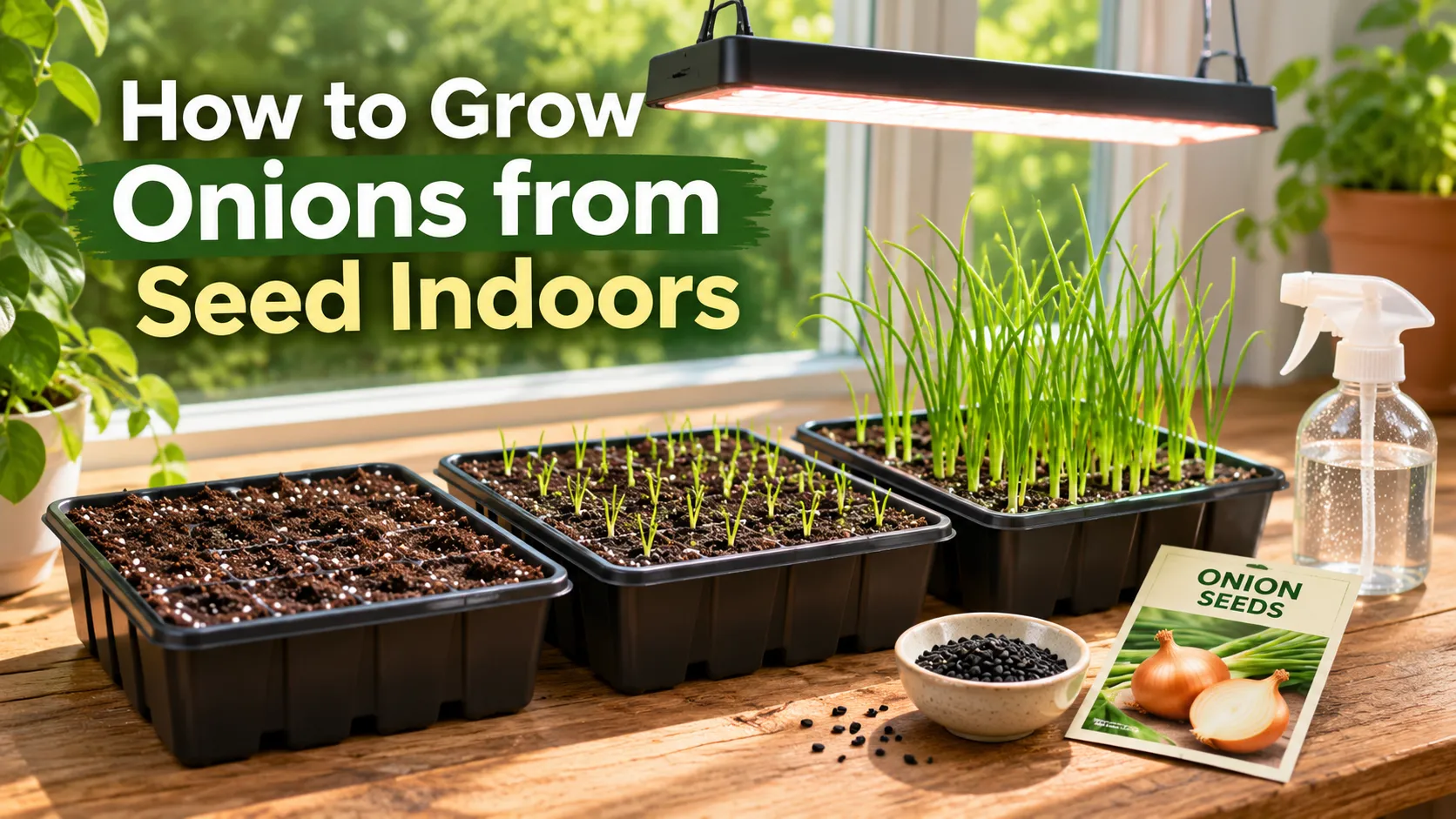
Most gardeners grab onion sets from the garden center and stick them in the ground. That works fine, but it limits you to whatever three or four varieties happen to be on the shelf. Learning how to grow onions from seed indoors opens up a completely different world — big sweet Walla Wallas, long-keeping storage types, red torpedoes, tiny pearl onions — all for a few dollars per packet.
The tradeoff? Time. Onion seedlings grow slowly, and you’ll be tending them indoors for a couple of months before they’re ready for the garden. But the work is simple, the supplies are cheap, and the results are worth it.
Seeds vs. Sets: Why Bother With Seed?
Onion sets are convenient, no question. But they come with limits. The variety selection is narrow, and because sets are small bulbs that have already been through one growing cycle, they’re more likely to bolt (send up a flower stalk too early) and can be more prone to disease.
Seeds give you access to hundreds of varieties. A single packet costs $3 to $4 and can grow 200-plus plants. According to Fine Gardening, seed-grown onions also tend to store better and bulb up faster than those grown from sets. If you’ve got a grow light and a couple of seed trays, there’s really no reason not to try it.
Choose the Right Onion Type for Where You Live
This is the step people skip — and then wonder why their onions never formed proper bulbs.
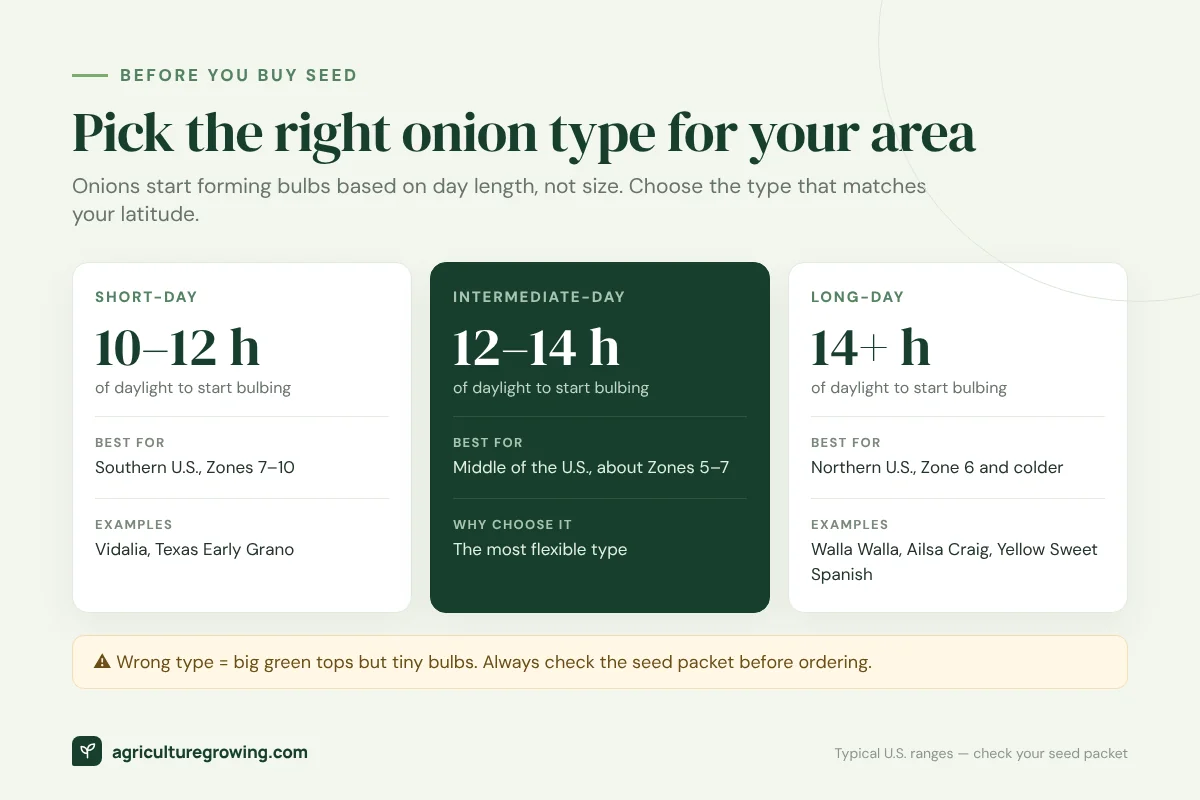
Onions don’t start bulbing based on size or age. They respond to day length — the number of hours of sunlight they receive. Plant the wrong type for your latitude, and you’ll get leafy green tops with nothing much happening underground.
Short-day onions begin bulbing at about 10–12 hours of daylight. They’re suited to the southern U.S. — USDA Zones 7 through 10. Think Vidalia and Texas Early Grano.
Intermediate-day onions need 12–14 hours. They’re the most flexible and work well across the middle of the country, roughly Zones 5 through 7.
Long-day onions won’t start forming bulbs until they’re getting 14 or more hours of daylight. These belong in Zone 6 and colder — the northern states. Walla Walla, Ailsa Craig, and Yellow Sweet Spanish all fall in this group.
A gardener in Georgia planting a long-day variety will get plenty of green growth but tiny, disappointing bulbs. Always check the seed packet before ordering.
Timing: When to Start Seeds Indoors
Onions are slow. After 8 to 12 weeks indoors, most varieties still need another 90 to 120 days in the garden to form a full-size bulb, and they barely seem to move in those first few weeks indoors.
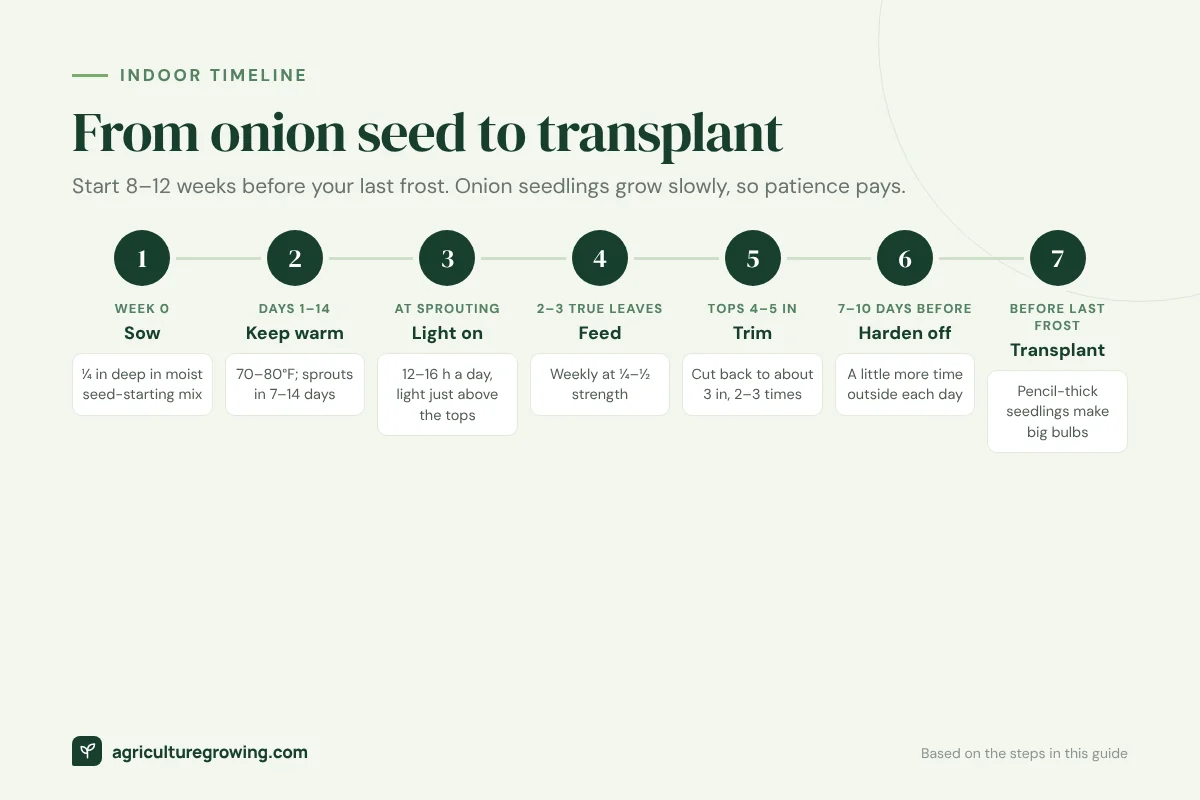
Plan to sow seeds 8 to 12 weeks before your last expected frost date. For much of the northern U.S., that puts sowing somewhere in late January to mid-February. Gardeners in the mid-Atlantic and central states usually aim for late February to early March.
Look up your last frost date through your local cooperative extension office or a planting zone website, then count backward. If you’re unsure, lean toward starting a little early. Onion seedlings handle extra indoor time well, and bigger transplants tend to produce bigger bulbs.
Supplies You’ll Need
Nothing fancy here:
- Fresh onion seeds — Buy new seed each year. Onion seeds lose viability fast and rarely germinate well after a year or two in storage.
- Seed-starting mix — A sterile, lightweight mix made for starting seeds. Don’t use garden soil — it’s too dense and may carry disease organisms.
- Containers — Shallow trays, cell packs, or repurposed plastic containers with drainage holes. Onion seedlings grow fine bunched together, so individual pots aren’t necessary.
- A grow light — This makes a real difference. A south-facing window can work, but a basic fluorescent or LED shop light produces much sturdier plants.
- A spray bottle or small watering can
- A humidity dome or plastic wrap — Helpful for holding moisture during germination, though not strictly required.
How to Grow Onions From Seed Indoors: Step by Step
1. Moisten the seed-starting mix first.
Add water and stir until the mix feels like a wrung-out sponge — evenly damp, not soggy. Fill your containers to about half an inch below the rim and press the surface flat.
2. Scatter the seeds.
Space them roughly a quarter to a half inch apart across the surface. Precision isn’t critical — you can always thin later. Cover with about a quarter inch of mix and press gently.
One common question: do you need to soak onion seeds first? No. Soaking for 12–24 hours can shave a day or two off germination time, but dry seeds sprout perfectly well on their own.
3. Cover and find a warm spot.
Lay a humidity dome or loose plastic wrap over the tray and place it somewhere warm — 70–80°F is the target. On top of the refrigerator, near a water heater, or on a seedling heat mat. Light doesn’t matter yet; warmth does.
4. Wait for sprouts.
Expect to see the first seedlings in 7 to 14 days. Warmer conditions push germination toward the faster end of that range. You’ll notice a thin green loop poking through the soil surface. Within a day or two, it straightens into a single, grass-like blade.
5. Get them under light right away.
The moment you see green, remove the cover and move the tray under your grow light. This step is critical. Every day without strong light produces weaker, floppier seedlings.
Set fluorescent tubes 2–4 inches above the seedling tops and raise the fixture as they grow. Run the lights for 12–16 hours daily.
Taking Care of Seedlings Over the Next Several Weeks
Light
Weak light is the single biggest cause of thin, floppy onion seedlings. The late-winter sun through a window is usually too dim and too brief — seedlings stretch toward it and end up spindly.
A cheap two-tube fluorescent shop light does the job. Keep it 2–4 inches above the plants and raise it as they grow. After germination, hold the growing area at about 55–65°F. Cooler air plus strong light produces the stocky, sturdy seedlings you’re after.
Watering
The goal is consistent moisture without soggy soil. Bottom watering — setting the tray in a shallow dish of water and letting the mix absorb it from below — works well because it keeps the surface drier and reduces the risk of damping off. If you water from above, use a gentle spray.
Let the top of the mix dry slightly between waterings, but don’t let it go bone dry. Onion roots sit near the surface, and seedlings wilt quickly when the moisture disappears.
Feeding
Seed-starting mix has almost no nutrients, so your seedlings will run out of steam after a few weeks without help.
Hold off on fertilizer until the seedlings have two or three true leaves and stand about 2–3 inches tall. Then begin feeding once a week with a balanced, water-soluble fertilizer mixed at one-quarter to one-half the strength on the label. Seedling roots are tender — full-strength fertilizer can burn them. Taper off or stop feeding about two weeks before you plan to transplant.
Trimming
Here’s something that surprises a lot of first-time onion growers: you should give your seedlings a haircut. When the tops reach 4–5 inches, trim them back to about 3 inches with clean scissors.
Trimming keeps seedlings from flopping over under their own weight, encourages the roots to grow stronger, and produces thicker stems. You’ll probably need to trim two or three times over the indoor growing period. Don’t cut below 2 inches — the plant needs enough leaf to keep growing.
And don’t throw out the clippings. They taste like mild green onions and work well tossed into salads, soups, or eggs.
Troubleshooting Common Problems
Tall, floppy seedlings — Nine times out of ten, this is a light issue. Lower the grow light so it sits 2–4 inches above the tops, and keep temperatures on the cool side (55–65°F). Regular trimming helps manage the floppiness while you correct the conditions.
Seeds that don’t sprout — Old seed is the usual suspect. Onion seeds go downhill fast in storage, especially in warm or humid conditions. If the seed is fresh and nothing’s happening after two weeks, the soil may be too cold. Use a heat mat or move the tray to a warmer room.
Seedlings collapsing at the base — That’s damping off, a fungal problem triggered by too much moisture and not enough air movement. Always use sterile seed-starting mix, don’t overwater, and give the seedlings some airflow. Pull out any affected seedlings immediately so the fungus doesn’t spread.
Yellow or pale leaves — Could be underfeeding, overwatering, or not enough light. If you haven’t fertilized yet and the seedlings are several weeks old, a diluted feeding is a good first step. If the mix has been wet for days, let it dry out a bit before watering again.
Hardening Off Before Transplanting
Indoor seedlings that go straight into the garden usually get burned by sun, knocked around by wind, and stressed by temperature swings. They need a gradual introduction to outdoor conditions — a process called hardening off.
About a week to ten days before transplanting, start bringing the seedlings outside for short stretches. Set them in a sheltered, partly shaded spot for a couple of hours the first day, then bring them back in. Each day, leave them out a little longer and give them a little more direct sun. After about a week, they should be spending all day outdoors and tolerating mild nights just fine.
Onions are tough plants. The seedlings can handle light frost without damage, but bring them in if a hard freeze is expected.
Moving Seedlings Into the Garden
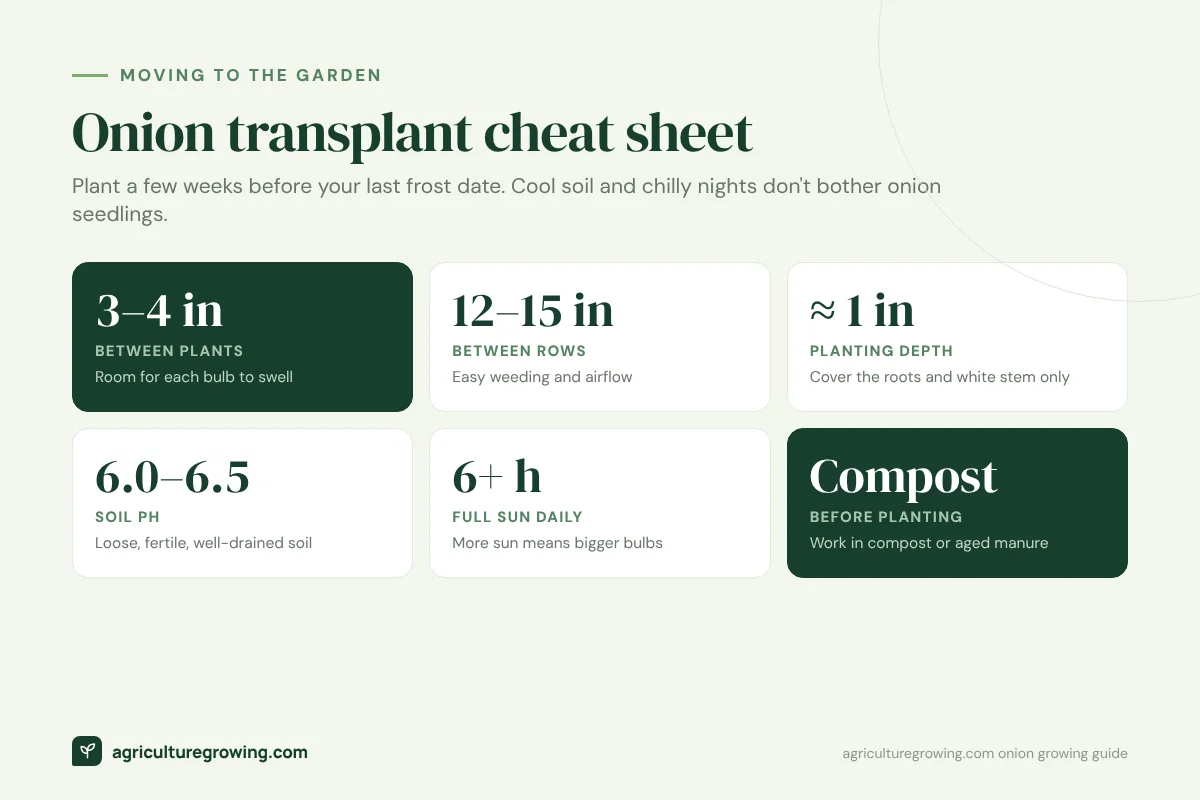
Onion transplants can go into the garden a few weeks before your last frost date. Cool soil and chilly nights don’t bother them.
Soil — Loose, fertile, and well-drained. Work in compost or aged manure before planting. Onions grow best in soil with a pH between 6.0 and 6.5.
Spacing — Set seedlings 3–4 inches apart in rows 12–15 inches apart.
Depth — About an inch deep, just enough to cover the roots and the white portion of the stem.
Sunlight — Full sun, at least 6 hours a day. More is better for bulb development.
Water gently after planting and keep the soil moist while roots get established. The ideal transplant size is about the thickness of a pencil — seedlings this size tend to produce the largest bulbs.
Frequently Asked Questions
How long does it take to grow onions from seed to harvest? Plan on about 8–12 weeks indoors as seedlings, then roughly 90 to 120 days in the garden from transplant to harvest, depending on the variety.
Can I grow onion bulbs entirely indoors? You can grow green onion tops indoors, but full-size bulbs are unlikely. Bulb formation depends on day-length cues that are hard to simulate with grow lights.
Do onion seeds need light to germinate? No. Warmth and moisture are what drive germination. Light becomes important only after the seedlings break through the soil surface.
How many times should I trim onion seedlings? Trim whenever the tops pass 5 inches, cutting back to about 3 inches. Most growers trim two or three times before transplanting.
What if I don’t have grow lights? A bright south-facing window can work, but expect thinner, leggier seedlings. Even a low-cost shop light hanging a few inches above the trays will produce noticeably stronger plants.
Wrapping Up
A packet of seeds, a bag of seed-starting mix, and a shop light — that’s really all it takes to grow onions from seed indoors. The process asks for patience more than anything else. You’ll spend a couple of months watering, feeding, and trimming what looks like a tray of grass. But once those seedlings hit the garden in early spring, they take off. By midsummer, you’ll have bulbs in sizes and varieties you’d never find at the store, and you’ll probably wonder why you ever bothered with sets.