
Rice feeds more than half of the world’s population and remains the backbone of food security across much of Asia, Africa, and parts of Latin America. As populations grow and arable land shrinks, farmers are under increasing pressure to increase production. using fewer resources. Traditional rice planting methods—such as broadcasting seeds or manual transplanting—often result in uneven spacing, wasted inputs, high labor requirements, and inconsistent yields from rice seeders.
Modern agriculture is moving toward more intelligent, more efficient systems, and one of the most essential innovations in rice production is the precision rice seeder. This technology allows farmers to place seeds at exact distances and depths, ensuring optimal plant spacing from the very beginning. Proper spacing is not a minor detail; it is a significant factor influencing higher yields, plant health, weed management, fertilizer efficiency, and final grain seeding yield. This article explores how precision rice seeders work, why planting spacing is essential, how modern precision farming has revolutionized rice farming, and how it benefits from this technology.
What Is a Precision Rice Seeder?
A precision rice seeder is a mechanical or semi-automatic machine designed to plant rice seeds in straight rows at uniform depth and consistent plant-to-plant distances. Unlike broadcasting, where seeds are scattered randomly, or traditional transplanting, where spacing depends on precise human judgment, a precision seeder follows a calibrated system to place seeds exactly where spacing is modern rice seeders needed.
A precise amount of seeders is used in both:
- Dry direct-seeded rice (DSR) systems
- Wet or puddled field seeding systems
They range from small hand-pushed devices for smallholder farmers to tractor-mounted and GPS-guided machines used on large commercial farms.
Why Planting Spacing Matters in Rice Farming
 Plant spacing plays a crucial role in rice farming because it directly affects plant growth, yield, and overall crop health. Proper spacing allows each rice plant to receive enough sunlight, nutrients, water, and air circulation. When plants are too close, they compete for resources, become weaker, and are more vulnerable to pests and diseases. Overcrowding also increases humidity within the crop canopy, which can encourage fungal agricultural machinery infections and lodging.
On the other hand, correct spacing promotes stronger root systems, better tiller formation, and uniform panicle development. It also makes field management practices, such as weeding, fertilization, and irrigation, more efficient. By maintaining optimal spacing, farmers can maximize grain yield in rice production, improve the precision of seeder operation, and ensure healthier, more productive rice fields.
Reduced Competition Between Plants
Reduced Competition rice planting Between Plants is an agricultural practice that optimizes plant spacing and resource management to ensure each crop has sufficient access to sunlight, water, and nutrients. By minimizing overcrowding, plants can grow healthier and stronger, leading to higher yields and better-quality produce. This approach reduces stress on individual plants, lowers the danger of disease transmission, and improves overall use value of rice seeder agricultural sow productivity.
Stronger Root and Tiller Development
Stronger sow rice seeds, roots, and tillers development are essential for tractor-harvested crops. Robust roots enhance nutrient and water absorption, improving plant resilience against drought and soil stress. Well-developed tillers increase the number of stems per plant, directly boosting grain or biomass production.
Together, strong roots and tillers support structural stability, reduce lodging risk, and optimize resource use efficiency. This foundational growth stage is critical for maximizing overall crop performance, ensuring plants achieve their full potential from seedling establishment to adjustable harvest.
Improved Light Penetration and Airflow
Even spacing improves the canopy seed metering structure. Sunlight can reach lower leaves, increasing photosynthesis. Better airflow reduces moisture buildup, lowering the risk of fungal diseases and pest infestations.
With precision spacing, fertilizers and irrigation water are used more effectively. Nutrients are absorbed by crops rather than being lost to runoff, leaching, or excessive vegetative growth.
Uniform Crop Growth and Maturity
Precision planting produces crops that emerge and mature more evenly. This simplifies weed control, fertilizer scheduling, and harvesting, and often improves the use of a rice seeder for grain furrow quality.
How Precision Rice Seeders Work
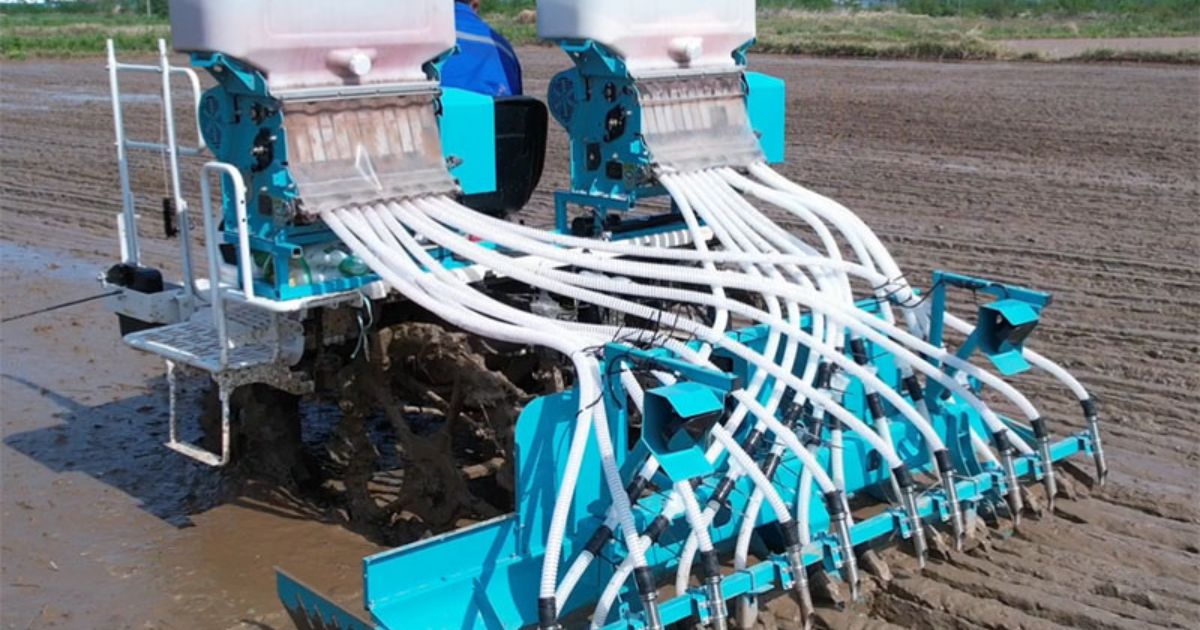
 Although designs vary, the seed distribution of most precision rice seeders shares similar components:
- Seed hopper to store seeds
- Metering system to control seed release
- Furrow openers to create planting lines
- Seed tubes to deliver seeds
- Covering device to close the soil over the seeds
- Press wheels or rollers for firm seed-to-soil contact
The metering system is the most crucial part. It may use rotating plates, rollers, or vacuum mechanisms to release single seeds or small groups at fixed intervals. This crop yield ensures that seeds fall into the soil at consistent distances.
The machine moves modern farming across the field in straight lines, creating rows with uniform spacing and depth. Many modern seeders also allow fertilizer to be placed at the same time, further improving efficiency.
Recommended Planting Spacing for Rice
Recommended depth and spacing for rice are crucial for healthy growth, efficient nutrient use, and high yields. Proper spacing allows each rice plant to receive enough sunlight, air circulation, and soil nutrients, reducing competition and the risk of pests and diseases. In traditional transplanted rice systems, farmers commonly use spacings of 20 × 20 cm or 20 × 15 cm, depending on the variety and soil fertility.
Wider spacing encourages stronger root development and more productive germination tillers, while closer spacing can increase plant population in fertile fields. Adjusting spacing based on variety, season, and management method in rice cultivation helps improve crop uniformity, simplifies weeding, and ultimately supports better grain precision, rice quality, and harvest, improving crop performance.
Common Spacing Ranges
- Row spacing: 20–25 cm
- Plant-to-plant spacing: 10–20 cm
- Seeds per hill: 1–3 seeds
Spacing depends on:
- Variety type (hybrid, inbred, traditional)
- Soil fertility level
- Irrigation method
- Climate and season
- Weed pressure
Precision rice reduced-labor seeders allow farmers to fine-tune these settings and manual planting, optimizing spacing for local, precise seed conditions rather than relying on estimates.
Types of Precision Rice Seeders
 Precision rice seeders are specialized machines designed to place seeds at precise depths, spacings, and rates, improving germination and crop uniformity. Common types include manual drum seeders, ideal for small farms and wet fields; mechanical row seeders, which rice seeder may ensure consistent line sowing; pneumatic precision seeders, using air pressure to singulate and deliver individual seeds; direct-seeding machines, suitable for dry or moist soils; and transplanter-style precision seeders, adapted for nursery-raised seedlings.
Each type supports reduced seed waste, better plant spacing, lower labor demand, and higher yields, making them essential tools for modern, precision-based rice cultivation, time- and labor-saving systems.
Manual and Push-Type Precision Seeders
These lightweight machines are designed for small and medium farms. They are needed for manual labor, pushed by hand, and for crop establishment, which releases seeds through a simple weed control metering system.
Advantages:
- Affordable and easy to maintain
- No fuel or electricity required
- Suitable for dry direct seeding
- Reasonable control over row spacing
They are ideal for smallholders transitioning from broadcasting to modern planting methods.
Drum Seeders for Wet Fields
Drum seeders are widely used in puddled rice fields. Pre-germinated seeds are placed in consistent seed-rotating drums with holes that release seeds in rows as the device is pulled across wet soil.
Advantages:
- Uniform row formation
- Reduced labor compared to transplanting
- Faster planting
- Suitable for community and cooperative farming
These seeders are especially popular in regions where waterlogged conditions dominate rice production.
Mechanical and Tractor-Mounted Seeders
These high-capacity soil machines are designed for crop management on large farms. They offer accurate control over larger areas, row width, depth, and seed rate.
Advantages:
- High efficiency and speed
- Consistent spacing across large areas
- Reduced labor costs
- The capability to apply fertilizer simultaneously
They work best in well-leveled fields and commercial farming systems.
Smart and GPS-Based Seeders
The newest precision rice seeders use sensors, satellite positioning, and onboard rice variety uniform seed computers.
Advantages:
- Extremely accurate row alignment
- Automatic depth and spacing adjustment
- Reduced overlaps and missed areas
- Data collection for farm management
These seeders represent the future of precision agriculture.
Benefits of Precision Rice Seeding
 Precision rice seeding is a modern planting approach that uses a calibrated KSNM rice seeder to place seeds at uniform depth and spacing. Its most significant benefit is higher germination rates and more even crop establishment, leading to more vigorous plants and improved yields. By reducing seed wastage and overlap, farmers can lower input costs while achieving optimal plant populations. Precision seeding also improves weed management because evenly spaced rice competes better for light and nutrients.
Uniform stands make fertilizer application, irrigation, and harvesting more efficient, saving time and labor. Overall, precision rice seeding supports sustainable production by increasing productivity, conserving resources through hand-seeding, and delivering predictable harvests.
Increased Yield Potential
Increased yield rice seeders, which reflect better crop potential, refer to the ability of modern farming practices, improved seeds, and advanced technologies to produce more crops per consistent seed distribution unit of land. By optimizing soil health, irrigation, fertilization, and pest management, farmers can maximize plant growth and reduce losses.
This leads to higher productivity, greater soil resource efficiency, and greater food security. Increased yield potential not only boosts farm profitability but also supports crop growth to meet the needs of a growing global population while minimizing the need to expand agricultural land.
Reduced Seed Requirement
Traditional broadcasting may require 60–80 kg of seed per hectare. Precision seeders often reduce this to 20–35 kg, lowering production costs while improving plant vigor. Precision seeding eliminates or reduces the need for nursery contributions to sustainable agriculture, reduces the need for raising and transplanting, saves time, and reduces labor-intensive Weed Control.
Clearly spaced rows allow mechanical weeders to operate efficiently. Early weed removal seed metering device reduces competition and lowers herbicide use. Direct seeding combined with precision spacing supports alternate wetting and drying, improving water efficiency and reducing methane emissions from seeding.
Precision Rice Seeders and Sustainable Agriculture
Precision rice seeders are revolutionizing modern farming by enabling accurate seed placement and uniform spacing, thereby enhancing crop yield and reducing seed waste. By optimizing planting patterns, these machines support efficient water and nutrient use, promoting eco-friendly practices. Their precision reduces the need for excessive fertilizers and minimizes soil disturbance, aligning with sustainable agriculture goals.
Farmers benefit from labor savings, higher productivity, and consistent crop quality. Integrating precision rice seeders into rice cultivation increases profitability and promotes long-term environmental sustainability, making them a key tool for future-ready farming.
Field Preparation for Best Results
The cornerstone of successful farming is field preparation. and high crop yields. It begins with clearing debris, weeds, and previous crop residues to create a clean growing surface. Proper plowing or tilling loosens the soil, improves aeration, and helps roots penetrate easily. Leveling the field ensures uniform water distribution and prevents waterlogging. Adding organic matter or fertilizers at this stage enriches soil fertility and supports healthy plant growth.
Soil testing guides nutrient management and pH correction, ensuring crops receive precisely what they need. Well-prepared fields promote strong germination, efficient irrigation, reduced pest pressure, and ultimately, precision seeding, better harvest quality, and productivity.
Key requirements include:
- Well-leveled land
- Fine seedbed with good tilth
- Controlled moisture conditions
- Minimal crop residue on the surface
Laser leveling, shallow tillage, and timely irrigation significantly improve planting accuracy and crop emergence.
Challenges in Adopting Precision Rice Seeders
 Adopting precision rice seeders offers efficiency gains, but several challenges slow their widespread use. High initial investment costs often discourage small and medium-scale farmers, especially in developing regions. Limited access to technical training and after-sales support makes operation and maintenance difficult.
Variations in field conditions, such as uneven terrain, excess moisture, and differences in soil type, can reduce seeding accuracy. Farmers may also face compatibility issues with existing machinery and traditional farming practices. Additionally, a lack of awareness, financing options, and reliable spare parts can hinder adoption. Overcoming these barriers requires affordable technology, strong extension services, and supportive agricultural policies.
Initial Investment
Initial investment refers to the upfront money required to start a project, business, or system. It typically includes costs such as land or space, equipment, tools, raw materials, installation, permits, and early operational expenses. This investment creates the framework for future expansion. A well-planned initial investment helps reduce long-term risks, improve efficiency, and ensure smoother operations.
Understanding initial costs clearly enables better budgeting, more informed decision-making, and stronger financial sustainability for agricultural equipment from the very beginning.
Need for Training
Training is essential for enhancing knowledge, skills, and efficiency in any professional or organizational setting. It equips individuals to meet evolving job demands, adapt to technological advancements, and maintain high performance standards. Well-structured training programs improve productivity, reduce errors, and foster employee confidence.
Additionally, training encourages innovation, teamwork, and career growth while aligning workforce capabilities with organizational goals. In today’s competitive soybean market, continuous learning and skill development through training are crucial for long-term success.
Field Limitations
Uneven fields or poor drainage from modern rice seeders reduce accuracy. Land seed spacing and depth preparation remain a crucial step. Different rice varieties respond differently to spacing. On-farm trials are recommended before full adoption.
The Future of Precision Rice Planting
 Precision rice modern rice planting is revolutionizing modern agriculture by combining technology, data, and sustainable practices. Advanced seeders, GPS-guided machinery, and AI-driven planting systems allow farmers to optimize seed spacing, reduce wastage, and improve crop yields. By monitoring soil conditions, moisture levels, and plant health in real time, precision planting ensures uniform growth and resource efficiency.
This approach not only boosts productivity but also reduces its environmental impact by using less water and chemicals. inputs. As global demand for rice rises, precision planting represents the future of efficient, high-tech, and environmentally responsible rice cultivation.
Conclusion:
Precision rice seeders represent a decisive shift from traditional, labor-intensive practices to efficient, science-based farming. By ensuring accurate planting spacing, these machines improve crop health, reduce waste, enhance weed control, significantly increase yields, and unlock the potential of rice.
In modern farming, the success of contemporary rice seeders begins with how seeds are planted. Precision rice seeders give farmers control over that crucial first step, transforming rice fields into well-organized, high-performance production systems. As the demand for food rises and climate challenges grow, technologies that optimize every input—starting with planting—will define the future of rice manual rice cultivation.
FAQ:
What is a Rice Seeder?
A rice seeder is a farming machine designed to plant rice seeds efficiently and uniformly in paddy fields. It replaces manual broadcasting, saving time and labor while improving crop spacing and yield.
How does a Rice Seeder Work?
Rice seeders distribute seeds evenly across the field using a mechanical or pneumatic system. Some models also create furrows, deposit seeds, and cover them with soil in a single pass, ensuring proper planting depth and spacing.
Are rice Seeders Cost-Effective?
Yes. Although the initial outlay is greater than that of manual labor, the savings in labor, time, and increased yield often make it cost-effective within a few cropping seasons.
Can I use a Rice Seeder for other Crops?
Some seeders are versatile and can plant wheat, barley, or legumes, but it depends on the seeder type and seed size. Specialized attachments may be required.
Where can I Buy a Rice Seeder?
Rice seeders are available from agricultural machinery dealers, local distributors, and online marketplaces. Consider field size, power source, and seed type when choosing a model.